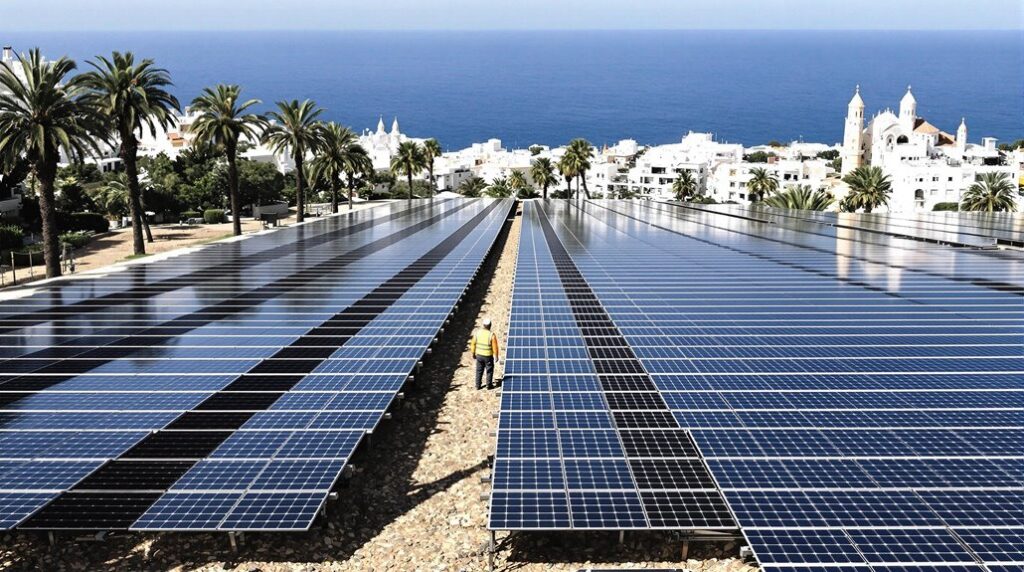
You’ll find that installing solar panels in Benalmádena is a highly advantageous investment, thanks to the region’s 300+ days of annual sunshine and 2,919 hours of sunlight yearly. A typical 4.5 kW system for a 120 sqm villa can generate around 5,843 kWh annually, reducing your electricity bills by 30-80% and saving approximately €1,684 per year. With EU Next Generation subsidies covering up to 40% of costs, you can expect to recover your initial investment within 3-5 years. The simplified permitting process, combined with Spain’s favorable renewable energy policies and tax incentives, makes this an ideal time to explore solar solutions.
Why Solar Panels Are Perfect for Villas in Benalmádena
If you’re considering solar panel installation for your villa in Benalmádena, you’ll benefit from the region’s impressive 300+ days of annual sunshine and advantageous Mediterranean climate, which generates up to 7.93 kilowatt-hours per day during peak summer months. Your villa’s spacious roof area provides the perfect platform for solar panel installation, allowing for the ideal 32-degree South-facing tilt that maximizes energy production throughout the year. Spain’s position as 10th globally for capacity adds confidence to solar investment decisions. With potential annual savings of up to €1500 for a standard 4.5 kW system and a typical payback period of just 5 years, you’ll be making a smart investment while contributing to environmental sustainability in Costa del Sol.
The Solar Potential of Andalucia
While many regions boast of their solar potential, Andalucia stands out as a premier location for solar panel installations, particularly in Benalmádena’s residential villas. With an impressive 3,344 hours of annual sunshine, you’ll benefit from ideal energy generation throughout the year, especially during summer when panels can produce up to 7.93 kWh/day per kilowatt. As one of Spain’s leading solar regions, Andalusia contributes 21.1% of the nation’s capacity.
You’ll find that Benalmádena’s diverse topography offers numerous installation opportunities, though coastal areas provide the most favorable conditions. To maximize your solar investment, you’ll want to position your panels at a 32-degree tilt facing south, with seasonal adjustments ranging from 20° in summer to 52° in winter. The region’s robust infrastructure and commitment to renewable energy, exemplified by projects like the Sanlucar la Mayor solar farm, guarantee you’re investing in a well-supported sustainable energy solution.
Why Villas Are Ideal for Solar Installations
Villas are ideal for solar installations because they provide expansive roof space and optimal sun exposure for maximum solar energy capture. These properties allow for large-scale panel deployment, making the most of natural sunlight throughout the day. The moderate roof angles of villas in Benalmádena ensure optimal performance and safe installation of solar systems.
Because villas in Benalmádena offer extensive roof space and ideal sun exposure, they’re perfectly suited for solar panel installations. You’ll experience significant reductions in electricity bills, especially if you’re operating power-intensive equipment, with the initial investment typically paying off within 3-5 years through energy cost savings.
Your villa’s value will increase substantially, as solar installations make properties more attractive to environmentally conscious buyers. You’ll gain energy independence, protecting yourself from grid fluctuations and power outages, particularly when combined with battery storage systems. Beyond the financial benefits, you’ll contribute to environmental preservation by reducing your carbon footprint and eliminating noise pollution. Government subsidies and tax benefits further enhance the long-term savings, making solar installation a practical investment for your villa.
Year-Round Sunshine in Benalmádena
Yes, Benalmádena enjoys year-round sunshine with 2,919 hours of annual sunlight and over 320 sunny days per year.
With mild temperatures averaging 17.4°C, Benalmádena provides ideal conditions for consistent solar energy production throughout the seasons.
The city experiences peak sunshine hours of 11.6 daily in July and maintains 5.5 hours in December. Solar panels in this climate can generate up to 7.93 kilowatt-hours per day for each installed kilowatt during summer months, with reduced but significant output in autumn and winter.
For optimal performance, solar panels should be installed at a 32-degree tilt facing south, though adjusting between 20° and 52° seasonally can enhance production, particularly during winter’s limited sunlight periods.
Cost Savings: Lower Electricity Bills for Villas
Villa owners can significantly lower their electricity bills by installing solar panels in Benalmádena. A typical 120-square-meter villa can generate 5,843 kilowatt-hours annually, resulting in savings of 1,684 euros per year. Electric bills typically decrease between 30% and 80%, depending on consumption and system size. Installations require 12.5 to 20 square meters of sun-exposed roof space for optimal energy production.
EU Next Generation subsidies cover up to 40% of installation costs, reducing the break-even period from 5-6 years to just 3-4 years. With solar panels lasting 20-25 years, owners benefit from substantial savings after recovering their initial investment.
Eco-Friendly Benefits of Solar Energy
Solar energy delivers major environmental advantages by eliminating greenhouse gas emissions, conserving water resources, and protecting natural habitats. The installation of solar panels in sunny regions like Benalmádena allows property owners to significantly decrease their carbon footprint while supporting local ecosystem health and improving regional air quality. Since solar installations can be mounted on existing buildings, they preserve undeveloped land and avoid disrupting wildlife areas. With an impressive 25 to 30 years of reliable operation, these sustainable energy systems provide lasting environmental benefits for generations to come.
How Solar Adds Value to Your Villa
Solar adds significant value to your villa through substantial energy cost savings of around 1,684 euros annually for a 120 sqm property, delivering return on investment within five years. Additionally, the installation enhances your villa’s market value by increasing its energy efficiency, making it more appealing to environmentally conscious buyers and renters in Benalmádena’s rising property market. With today’s technology, modern solar panels have a 25-30 year lifespan and require minimal maintenance to maintain optimal performance.
The Basics of Solar Panel Installation
Solar panel installation involves five key steps:
- Site Assessment: Evaluate roof compatibility, structural condition, and sunlight exposure, ensuring 12.5-20 square meters of available space.
- Mounting System: Install support structures at 15-20 degree angles for optimal sun exposure. For flat roofs, concrete ballasts are utilized to securely anchor the mounting structure.
- Panel Placement: Secure solar panels using stainless steel components onto mounting frames.
- Electrical Setup: Connect panels through proper wiring and install inverter systems.
- System Testing: Verify connections and performance, accounting for 18% efficiency loss due to environmental factors.
The system typically covers 50-70% of annual electricity needs, with peak production occurring during 2-3 hours of direct sunlight.
Choosing the Right Solar System for Your Villa
To choose the right solar system for your villa, evaluate your energy needs against Benalmádena’s solar potential, which generates 7.93 kWh/day in summer and 3.10 kWh/day in winter per kilowatt installed.
Since Benalmádena’s abundant sunshine and favorable climate create ideal conditions for solar power, investing in a solar system for your villa can yield substantial returns. Your system should be installed at a 32-degree tilt facing south, though seasonal adjustments can optimize performance. Given the coastal location, you’ll want to select salt-resistant materials and plan for regular maintenance. The carbon-neutral design can be achieved through proper initial planning and installation. With potential annual savings of up to €1500 for a 4.5 kW system and available subsidies covering 30% of costs, you can expect a return on investment within 4-5 years.
Local Regulations and Incentives for Solar in Andalucia
Solar regulations and incentives in Andalucia include simplified permitting requirements and financial benefits. No building permit is required – only a «Responsible Declaration» submission to the municipal government with a technical design report from a qualified engineer. Regular safety inspections required after installation ensure ongoing compliance with local electrical codes.
Key incentives available:
- A 20% tax deduction from the Spanish Tax Agency on installation costs
- Property tax rebates of up to 50% for 10 years, depending on your municipality
- Regional subsidies specific to Andalusia to help offset initial expenses
Systems under 100kW do not require environmental authorization. Zero injection setups are exempt from distributor permits, streamlining the installation process.
Future-Proofing Villas with Solar
Future-proofing villas with solar requires installing high-efficiency monocrystalline panels positioned at a 32° south-facing angle. Photovoltaic cells convert sunlight directly into usable electricity through sophisticated semiconductor technology. The system delivers immediate cost savings through reduced electricity bills, protection against rising energy prices, and potential income from selling excess power to the grid.
Smart solar technology with real-time monitoring and predictive maintenance ensures optimal system performance, while battery storage provides reliable clean energy access. Beyond operational benefits, solar installations can increase property values by up to 6.8% and appeal to sustainability-minded buyers.
With abundant sunshine in Benalmádena, converting to solar power represents a strategic investment that combines financial returns with environmental conservation through reduced carbon emissions.
Step-by-Step Guide to Solar Panel Installation for Villas
Installing solar panels at your villa begins with a thorough assessment of your property’s solar potential, including factors like roof orientation, shading patterns, and available space for ideal panel placement. You’ll need to carefully select the right components, including panels rated for your energy needs, inverters that match your system design, and potentially batteries if you’re planning for energy storage. Local estimates suggest two hours per panel installation timeframe for a complete system setup. Working with a certified installer in Benalmádena will guarantee proper system integration, from mounting the panels on anodized aluminum structures to connecting the inverter and configuring the monitoring system for peak performance.
Solar Panel Installation Process
The solar panel installation process involves multiple stages:
Successfully installing solar panels on your villa requires careful planning and a systematic approach that typically spans several weeks. Remote assessments and digital surveys are often conducted to ensure efficient property evaluation. You’ll need to begin with property assessment and system design, followed by obtaining necessary permits, which can take up to seven weeks depending on your municipality.
The installation process follows three main phases:
- Site preparation, including scaffolding setup and mounting structure installation
- Panel attachment and electrical system integration, comprising inverter installation and wiring connections
- Testing and certification, involving city inspection and utility company approval for operation
After installation, you’ll need to register for solar export tariffs and set up monitoring systems. The entire process concludes with final commissioning to guarantee your system operates at peak efficiency, providing sustainable energy for your villa.
Assessing Your Villa’s Solar Potential
Your villa’s solar potential can be determined through four key assessments. First, analyze your site’s geographic coordinates and calculate average daily sun hours using specialized tools like Sunbase or PVWatts. Second, evaluate potential shading issues from surrounding structures and vegetation, utilizing solar pathfinders to measure sunlight exposure throughout the day. Third, determine the ideal array orientation, typically south-facing for maximum efficiency, while considering your specific latitude and seasonal variations. Fourth, verify installation feasibility by examining available space, checking local regulations, and ensuring compliance with safety requirements. Don’t forget to factor in your villa’s electrical demands and investigate financial incentives that could offset your installation costs. A comprehensive roof condition assessment should be performed to ensure your structure can support the weight of the solar panel system.
Selecting the Right Type of Solar Panels
The best type of solar panels for most installations is monocrystalline, offering optimal efficiency and performance.
After evaluating your villa’s solar potential, the next major decision involves choosing the right type of solar panels for your installation. While there are several options available, monocrystalline panels often provide the best balance of efficiency and performance for residential properties, offering 17-22% efficiency ratings and power outputs of 320-375 watts or higher. These premium panels are manufactured using the Czochralski process, resulting in superior electron flow.
When selecting your panels, consider these key factors:
- Space efficiency: Monocrystalline panels require less roof space than polycrystalline (15-17% efficiency) or thin-film options (7-10% efficiency)
- Aesthetic impact: Monocrystalline panels feature a sleek black appearance that’s less conspicuous
- Long-term value: Despite higher upfront costs, monocrystalline panels deliver superior lifetime output and durability
Your choice should align with your budget constraints while maximizing energy production for your villa’s specific requirements.
Choosing the Best Solar Installer in Benalmádena
The best solar installer in Benalmádena should have local licenses, certifications, and insurance specific to Costa del Sol solar installations, plus an established track record of successful projects in the area.
Selecting the right installer requires verifying their credentials and reviewing their portfolio of completed installations in Benalmádena. A qualified company will conduct a comprehensive site assessment, analyzing roof condition, optimal panel positioning (32° South), and potential obstacles. Quality installers will also perform a detailed electrical infrastructure review to ensure your property’s system is compatible with solar integration. They must understand local environmental challenges, particularly salt spray exposure, and implement appropriate protective measures.
Your chosen installer should manage all permit requirements, provide thorough documentation for local authorities, and offer robust maintenance plans and warranties that specifically cover salt corrosion protection. Look for companies with an established physical presence in the region who can provide long-term service support.
Understanding System Components: Panels, Inverters, Batteries
The three essential components of a solar power system are panels, inverters, and batteries, each serving distinct functions in solar energy generation and storage.
A successful solar installation starts with understanding these three core components:
- Solar panels use photovoltaic cells to transform sunlight into DC electricity, requiring secure mounting to withstand environmental conditions. High-quality racks contribute significantly to the system’s long-term durability and performance.
- Inverters convert DC power to AC electricity while managing power quality and providing system monitoring capabilities
- Batteries, working with hybrid inverters, store surplus energy and provide backup power during outages or low production periods
When planning your villa’s solar installation, you’ll need to guarantee all components are properly sized and compatible with each other to maximize system efficiency and reliability.
Pre-Installation: Site Inspection and Planning
Pre-installation site inspection and planning requires a comprehensive evaluation of your property and energy needs before any solar components can be mounted. The process involves two main phases:
Physical Site Assessment:
- Evaluate ideal panel placement locations
- Analyze shading patterns throughout the day
- Check roof orientation and structural integrity
- Identify potential obstructions from trees or buildings
- Verify adequate roof space for planned system size
- Schedule a professional inspector visit to assess structural safety requirements
Technical Planning:
- Calculate household energy requirements
- Review historical energy consumption data
- Determine appropriate system size and configuration
- Secure necessary permits
- Ensure compliance with local building codes
- Verify structural requirements
- Plan grounding systems
- Establish safety measures meeting local standards
Installation Day: What to Expect
On installation day, expect a professional team to arrive at your property with equipment to complete a full solar system setup through three main phases:
- Site preparation – clearing debris, measuring positions, and verifying structural integrity
- Panel mounting – assembling the racking system and securing panels with proper alignment. The team will ensure proper weather sealing using caulk and specialized tape for all connections.
- Electrical integration – running conduits, connecting wiring, and installing safety devices
The team will work systematically from mounting panels to making final electrical connections. They will ensure all components meet local codes and safety standards while setting up monitoring systems to track performance. The process ends with preliminary testing before scheduling the final inspection.
Post-Installation: System Testing and Setup
System testing and setup after solar panel installation requires conducting three key tests and verifying proper operation. First, measure open circuit voltage (VOC) using a multimeter – expect 18-28V for 12V panels or 34-56V for 24V panels. Then check short circuit current (ISC) by connecting the multimeter to measure current output. Perform load testing by connecting either two 12V 21W globes in series or a single 24V 55W incandescent globe to verify illumination. Complete the process by using a resistance box to identify the maximum power point, measuring voltage and current outputs. Compare all measurements against the panel’s specifications to confirm proper functioning. Testing should be conducted in full sunlight conditions for accurate and reliable results.
Maintenance Tips for Long-Term Efficiency
Maintaining long-term efficiency of solar panel systems requires regular cleaning, inspections, and protective measures.
To maintain your solar panel system’s peak efficiency, implementing a thorough maintenance routine is vital. You’ll need to regularly clean your panels using soft cloths and gentle cleaning solutions, while also inspecting for loose connections and wear. It’s important to monitor your inverter’s performance and guarantee all components are functioning at their best. Installing a monitoring platform will provide real-time data on your system’s performance and alert you to potential issues.
- Schedule quarterly inspections of mounting hardware and electrical connections to prevent system failures
- Clean panels during early morning or evening hours when they’re cool, using non-abrasive materials and deionized water
- Trim surrounding vegetation bi-annually to prevent shade coverage, and check for any damage after extreme weather events
For maximum longevity, you’ll want to apply protective coatings every few years and integrate energy storage solutions to enhance your system’s overall performance.
Final Steps: Connecting to the Grid
Connecting to the grid requires DNSP approval, compliant inverter setup, and proper technical verification as the final installation steps.
After installing your solar panels and inverters, connecting to the power grid marks the final essential phase of your installation project. You’ll need to secure approval from your local Distribution Network Service Provider (DNSP) and guarantee your system meets export limits and technical requirements. Modern smart inverters help optimize the energy flow between your solar system and the grid.
| Connection Steps | Key Requirements |
|---|---|
| Initial Approval | DNSP authorization |
| System Integration | Inverter compliance |
| Power Flow Setup | Bi-directional metering |
| Final Inspection | Technical verification |
Your inverter will convert DC power to AC electricity, while transformers adjust voltage levels for grid compatibility. The electricity then flows through transmission lines and substations before reaching the distribution network. For larger installations, you’ll likely need an energy professional to negotiate with distributors and guarantee proper integration with existing infrastructure.
The Cost of Installing Solar Panels in Benalmádena
When you’re planning to install solar panels in Benalmádena, you’ll need to evaluate costs ranging from €2,000 to over €15,000, depending on your villa’s size and energy requirements. Your total investment will include essential components like solar panels (€100-€400 each), inverters (€400-€1,800), mounting systems (€400-€1,200), and optional battery storage (€2,000-€10,000). While Spain no longer offers national subsidies, you can benefit from a 20% tax deduction through the Tax Agency of Spain, making the investment more financially manageable. With Benalmádena enjoying over 300 sunny days annually, solar panel installations can provide excellent returns on investment.
Breaking Down Solar Installation Costs
The total cost breakdown for a 5kW solar installation in Benalmádena ranges from €5,500 to €12,000, depending on equipment quality and installation complexity.
Understanding the costs of solar panel installation in Benalmádena requires breaking down several key components. When you’re planning your solar investment, you’ll need to take into account the primary cost elements that make up the total installation price. With proper planning and investment, homeowners typically see a 10-15% annual ROI on their solar installations.
- Solar Panels: €3,000 to €6,000 (€600-1,200 per kW)
- Inverter and Electrical Components: €1,000 to €2,000
- Installation and Labor: €1,000 to €3,000, plus permits (€500-1,000)
You’ll also need to factor in Spain’s 21% IVA, though the government’s 40% subsidy can greatly offset your costs. If you’re contemplating a battery system, you’ll need to add approximately €6,000 for a 10kW capacity storage solution.
How Villa Size Affects Solar System Costs
The cost of a solar system directly correlates with villa size:
- Small villas (2-3 bedrooms): 5,000 euros for 2-3 kW system, saving 1,684 euros annually
- Medium villas: 7,500 euros for 7.5 kW system
- Large villas (4-6 bedrooms): 10,000+ euros for 10 kW system
System costs are also influenced by:
- Villa orientation (south-facing optimal)
- Seasonal solar exposure (summer: 7.93 kWh/day, spring: 6.16 kWh/day)
- Panel tilt angle (32-degree recommended for Benalmádena)
Many luxury villas featuring energy-efficient designs are already primed for solar panel installation.
Panel Types and Price Ranges
Panel Types and Price Ranges:
Homeowners in Benalmádena can choose from three main panel types: monocrystalline, polycrystalline, and hybrid systems. Current prices range from €600 to €1,200 per kW for panels, with total system costs between €5,000 and €12,500 for a standard 5 kW installation. Installing larger systems can lead to lower costs per watt due to bulk pricing advantages.
System price categories:
- Basic self-assembly systems start at €2,000 with limited production
- Standard professional installations range from €5,000 to €12,500
- Advanced systems with premium features can exceed €15,000
Additional costs include installation fees (€1,000-€3,000), permits, and professional installation services, which cover system legalization and warranty coverage.
Additional Costs: Inverters, Batteries, and Installation
Additional Costs for Solar Installation Include:
Inverters: 20% of total costs (€1,000-€2,000)
Batteries: €2,000-€10,000 (optional)
Installation and labor: 20% of total costs (€1,000-€3,000)
Mounting equipment: 15% of total costs (€400-€1,200)
Cabling materials: €400-€1,200
Energy meters and surge protection components (included in professional installation)
Modern inverters utilize MPPT technology to maximize energy production from your solar panels throughout the day. These components complement the solar panel system and are essential for a complete, functioning installation. Battery storage, while optional, can be beneficial for high electricity users or electric vehicle owners.
Government Incentives and Grants in Andalucia
Government incentives and grants for solar energy in Andalucia include reimbursements of up to 40% through the EcoVivienda Plan, with maximum rebates of €3,000 per installation.
Financial incentives make solar panel installation in Benalmádena considerably more affordable through the EcoVivienda Plan, which offers reimbursements up to 40% of total costs with a maximum rebate of €3,000. The Andalusian government has allocated 614 million euros to support these energy efficiency initiatives. You’ll need to meet specific requirements and submit your application before December 26, 2024, to take advantage of this regional government-backed initiative.
To qualify for these incentives, you must:
- Own a home built before 2017 that serves as your primary residence
- Achieve a 30% reduction in traditional energy consumption
- Submit all required documentation, including certificates and title deeds
Additional local incentives include IBI tax rebates, which vary by municipality. You can also explore financing options with interest-free payments for up to 36 months, making the shift to solar energy even more accessible.
ROI: When Will You Break Even?
Your solar installation will typically break even in 8 to 12 years without subsidies, or 3 to 4 years with government support.
While government incentives make solar installations more attractive, understanding your return on investment helps determine if it’s the right choice for you. Your break-even timeline depends on several key factors, including your initial investment, which ranges from €2,000 to €15,000, and local electricity costs. With solar panels lasting 25 years or longer, the investment provides decades of benefits. Benalmádena’s abundant sunlight, particularly during summer (7.93 kWh/day) and spring (6.16 kWh/day), makes it an ideal location for solar energy production. You’ll maximize your ROI by properly sizing your system to match your household’s consumption patterns and by using the produced electricity rather than selling it back to the grid.
Solar Financing Options for Villa Owners
Solar financing options for villa owners include three primary paths: cash purchase, solar loans, and third-party ownership arrangements.
Three main financing paths are available for villa owners considering solar panel installation in Benalmádena. Each option offers distinct advantages based on your financial situation and long-term goals.
- Cash purchase provides maximum savings over time, immediate ownership, and full eligibility for incentives, including the federal investment tax credit
- Solar loans offer low-to-no upfront costs while maintaining ownership benefits, with monthly payments typically lower than traditional energy bills
- Third-party ownership arrangements, such as leases and PPAs, eliminate upfront costs and maintenance responsibilities, though you won’t own the system
Your choice will depend on factors like available capital, credit score, and desired level of responsibility for maintenance. Solar loan terms typically run 10 to 20 years with fixed interest rates. With current subsidies covering up to 40% of installation costs, you’ll find the investment more accessible regardless of your chosen financing method.
Hidden Costs to Watch For
The main hidden costs to watch for when installing solar panels in Benalmádena include electrical upgrades (€500-€2,000), roof preparation (€400-€1,500), annual maintenance (€200-€500), and component replacement (€1,000-€3,000).
Several hidden costs could impact your total investment beyond the advertised base price. You’ll need to account for potential electrical upgrades in older homes, roof preparation work, and ongoing maintenance expenses. Additionally, equipment replacement costs and battery maintenance can add significant expenses over time. Despite these costs, homeowners can expect long-term savings exceeding €30,000 over 20 years.
| Cost Category | Potential Range |
|---|---|
| Electrical Upgrades | €500 – €2,000 |
| Roof Preparation | €400 – €1,500 |
| Annual Maintenance | €200 – €500 |
| Component Replacement | €1,000 – €3,000 |
System monitoring services and potential price escalators in solar lease contracts should be carefully considered. You’ll also want to factor in regulatory approval fees, which can range from €500 to €1,000, and any municipality-specific charges that might apply to your installation project.
How Solar Reduces Long-Term Energy Expenses
Solar power reduces long-term energy expenses by generating free electricity from sunlight, replacing costly utility power. In Benalmádena, solar panels can generate up to 7.93 kWh per day during peak summer months when tilted at 32 degrees facing South, taking advantage of the region’s 320+ sunny days annually. With Benalmádena offering a 75% ICIO discount, homeowners can significantly reduce their initial installation costs.
Your long-term savings are achieved through:
- Locked-in electricity rates that protect you from rising utility costs over 25+ years
- Daily generation ranging from 3.10 kWh in winter to 7.93 kWh in summer per kilowatt installed
- Available tax credits and local incentives that notably reduce your initial investment
These factors, combined with an 85% reduction in PV module costs since 2010, make solar installation an increasingly attractive investment for reducing your household expenses.
Is It Worth the Investment?
Yes, installing solar power in Benalmádena is worth the investment, particularly with available EU subsidies that can reduce payback time to 3-4 years.
Making the switch to solar power in Benalmádena involves a significant upfront investment, with costs ranging from €5,000 to €12,500 for a typical 5kW home system. You’ll need to take into account several components, including the panels themselves (€600-1,200 per kW), inverters (€1,000-2,000), and installation costs (€1,000-3,000). Regular maintenance costs remain minimal while ensuring optimal system performance over time.
While Spain no longer offers national energy subsidies, you can still benefit from EU Next Generation funds through regional authorities, which can cover up to 40% of your investment. With these incentives, you’ll likely see a return on investment within three to four years, compared to five to six years without subsidies. When you factor in long-term energy savings and the current electricity rates, installing solar panels in Benalmádena proves to be a worthwhile investment for property owners with suitable roof space.
How to Maximize the Efficiency of Your Villa’s Solar Panels
To maximize your villa’s solar panel efficiency in Benalmádena, you’ll need to understand how factors like panel technology, placement, and seasonal variations affect energy production. High-efficiency panels, such as monocrystalline or bifacial models with 18-22% efficiency rates, can greatly boost your system’s performance when properly installed on your villa’s roof at the ideal 30-35 degree tilt angle. Your roof’s orientation plays an essential role in energy capture, with south-facing installations typically generating the most power throughout Benalmádena’s sunny climate, while considering seasonal adjustments can help maintain consistent energy production year-round. Integrating a solar tracking system can further optimize energy collection by automatically adjusting panel angles to follow the sun’s daily path.
What Does Solar Efficiency Mean?
Solar efficiency refers to how effectively a solar panel system converts sunlight into usable electrical power.
The science behind solar panel efficiency reveals how effectively your system converts sunlight into usable electricity. When sunlight hits your panels, silicon or thin-film cells transform this energy into electrical current, which then flows through your home’s circuit breaker box. Today’s solar panels typically convert between 16% to 22% of sunlight into usable power, a considerable improvement from the early models that managed only 6% efficiency. Leading manufacturers like SunPower and Panasonic now produce panels reaching efficiencies up to 22.8%.
To understand your solar panel’s efficiency, consider these key factors:
- Temperature greatly impacts performance, with higher temperatures reducing output voltage
- Weather conditions, including cloud cover and rain, affect conversion rates
- Proper panel orientation and minimal shading are essential for ideal energy generation
Understanding these efficiency factors helps you maximize your solar investment‘s performance and longevity.
Choosing High-Efficiency Panels
High-efficiency solar panels offer optimal energy production and space utilization. Choose panels with N-type cells like TOPcon or HJT technologies, featuring efficiency ratings of 21-24.4%. These panels incorporate advanced cell architectures and high-purity silicon that minimize light-induced degradation. Larger 700W panel ratings are now available, maximizing sunlight capture potential per installation.
Half-cell designs and multiple busbar configurations enhance performance in shaded conditions. Round interconnection wires and anti-reflective coatings increase sunlight capture. Though black panels provide aesthetic appeal, white or lighter-colored backsheets deliver superior performance by maintaining lower operating temperatures and higher efficiency.
Optimal Placement for Panels in Benalmádena
The optimal placement for solar panels in Benalmádena requires panels to be mounted facing south at a 32-degree tilt angle for fixed installations.
Maximizing your villa’s solar efficiency in Benalmádena requires strategic panel placement that accounts for the region’s unique coastal and mountainous environment. To enhance your solar installation’s performance, you’ll need to take into account the ideal tilt angle of 32 degrees for fixed panels while factoring in the mountain shadows that can affect morning and late afternoon production. Professional installers can conduct a shading analysis to determine the most efficient placement locations.
For best results, follow these essential placement guidelines:
- Position your panels facing south to capture maximum year-round sunlight
- Install panels at least 20 degrees in summer and 52 degrees in winter if using adjustable mounts
- Calculate shadow patterns from nearby obstacles and maintain adequate spacing between panel rows
You’ll also need to protect your installation from coastal salt corrosion by selecting appropriate materials and implementing a regular maintenance schedule to guarantee sustained performance.
Impact of Roof Orientation and Tilt Angle
Roof orientation and tilt angle significantly impact solar panel performance and energy production. South-facing panels in Benalmádena’s Northern Hemisphere location achieve maximum efficiency, while east or west-facing orientations produce approximately 20% less electricity. North-facing roofs may require alternative mounting solutions like ground installations. Advanced tracking systems can boost energy production by up to 35% compared to fixed installations.
Your panels’ tilt angle should closely match Benalmádena’s geographical latitude for best year-round production. Even flat roofs need a minimum 5-10 degree tilt for proper debris and water drainage. Though perfect orientation and tilt maximize efficiency, modern solar systems can compensate for slight variations through proper sizing and design.
Seasonal Considerations for Energy Production
Seasonal considerations for energy production primarily depend on variations in sunlight exposure, temperature fluctuations, and weather patterns throughout the year.
Solar panel efficiency in Benalmádena fluctuates throughout the year due to seasonal variations in sunlight, temperature, and weather conditions. You’ll experience peak energy production during summer months, with panels generating approximately 7.93 kWh/day per installed kilowatt, while winter output drops to 3.10 kWh/day. Installing solar tracking systems can help maximize sun exposure throughout changing seasons.
To optimize your solar panel performance throughout the year:
- Schedule regular cleaning during dry summer spells to prevent dust accumulation
- Clear fallen leaves in autumn to maintain maximum exposure
- Monitor panel temperature during peak summer heat, as efficiency decreases above 25°C
While Benalmádena’s Mediterranean climate provides favorable conditions year-round, you’ll need to adjust your energy consumption patterns seasonally. Spring and autumn offer moderate temperatures that enhance panel efficiency, despite receiving less direct sunlight than summer months.
Cleaning and Maintenance for Efficiency
Proper cleaning and maintenance maximize solar panel efficiency through scheduled inspections, professional servicing, and regular cleaning protocols.
To maintain peak performance of your villa’s solar panels, proper cleaning and maintenance are vital components of ownership. You’ll need to schedule regular visual inspections and cleaning sessions at least twice yearly, though dusty environments may require more frequent attention. Professional technicians can perform thorough checks while monitoring systems track real-time performance data. Implementing an automatic cleaning system can significantly reduce maintenance workload and ensure consistent cleanliness.
| Maintenance Aspect | Frequency | Impact on Efficiency |
|---|---|---|
| Visual Inspection | Monthly | Prevents deterioration |
| Professional Check | Bi-annually | Guarantees ideal output |
| Basic Cleaning | Quarterly | Up to 21% improvement |
| System Monitoring | Daily | Identifies issues early |
| Deep Cleaning | Annually | Up to 60% enhancement |
Using soft materials and non-abrasive cleaners, you’ll protect your panels while removing efficiency-reducing debris. Remember, dirty panels can lose up to 25% efficiency, making regular maintenance essential for maximizing your solar investment’s performance.
Upgrading to Smart Inverters and Batteries
Smart inverters and batteries can be upgraded by installing modern equipment that offers:
- High-efficiency inverters (98.5%+) with real-time control and multiple MPPT channels
- Dynamic power flow management that stores excess energy and releases it during peak demand
- Advanced voltage regulation for equipment protection and grid stability
- Predictive maintenance features for early issue detection
The upgrades integrate seamlessly with battery storage systems to maximize self-consumption and reduce grid dependency while supporting grid stability through reactive power management. Smart inverters direct surplus power to storage during low demand periods and release it when needed, ensuring optimal energy utilization. Cloud-based monitoring enables continuous oversight of system performance and fault diagnostics through mobile applications.
Key benefits include:
- Dynamic power flow control
- Equipment protection through voltage regulation
- Preventive maintenance capabilities
- Enhanced energy harvesting
- Improved grid stability support
Monitoring Your System’s Performance
Monitoring your system’s performance requires installing a comprehensive tracking system that captures real-time data through cloud-based platforms, sensors, and smart inverters.
A thorough monitoring system forms the backbone of any efficient solar installation, enabling you to track and optimize your villa’s energy production. You’ll need to focus on key performance metrics while utilizing modern monitoring solutions that offer real-time insights into your system’s operation. Regular checks of these metrics help identify maintenance needs early, ensuring optimal system functionality.
| Monitoring Type | Primary Benefits | Key Features |
|---|---|---|
| Cloud-based | Remote access | Real-time data |
| Sensor-based | Early detection | Performance tracking |
| Smart inverter | System efficiency | Detailed analytics |
To maintain peak performance, you’ll want to implement an extensive monitoring strategy that includes regular panel inspections and data analysis. Modern monitoring apps enable you to track voltage, current, and temperature readings from anywhere, while built-in inverter systems provide detailed performance metrics that help identify potential issues before they impact your energy production.
Reducing Energy Waste in Your Villa
To reduce energy waste in your villa:
Maximizing your villa’s solar panel efficiency requires three essential strategies: ideal panel placement, effective cooling systems, and smart energy integration. You’ll need to minimize energy waste through strategic implementation and regular maintenance of your system. The installation of Energy Star appliances throughout your villa can significantly reduce overall power consumption.
- Install your panels facing due south at an angle matching your latitude, and use mirrors twice the panel’s size to boost output by up to 75%
- Implement water cooling systems or misting devices during peak hours to prevent overheating and maintain peak performance
- Integrate battery storage systems for peak shaving and utilize solar thermal technology for water heating
Tips for Peak Solar Efficiency
To guarantee your villa’s solar panels operate at peak efficiency, you’ll need to implement several proven enhancement strategies that encompass proper maintenance, strategic positioning, and advanced technology integration.
Conduct regular visual inspections every few months to check for damage or debris, and keep your panels clean using a garden hose or soft brush. Professional maintenance teams should perform annual inspections to ensure all electrical connections remain secure and safe. You’ll want to confirm your panels face true South if you’re in the Northern Hemisphere, adjusting the tilt angle based on your latitude. Consider implementing solar tracking systems and MPPT inverters to maximize energy production, and don’t forget to maintain clear surroundings by trimming vegetation that might cast shadows. For best results, schedule your high-energy activities during peak sunlight hours and monitor your system’s performance data regularly through energy management tools.
Government Incentives for Solar Panel Installation in Andalucia
Spain’s government actively supports solar energy adoption through extensive incentive programs, with Andalucia offering particularly attractive subsidies of up to 40% of installation costs. You’ll find significant tax benefits, including municipal tax rebates of up to 50% in cities like Seville, along with interest-free financing options that make solar installations more affordable. Through the EcoVivienda Plan, you can receive up to €3,000 in rebates for installing solar panels on your residential property, provided you meet specific eligibility requirements and submit your application before December 26, 2024. Certified professional installers must complete all solar panel installations to qualify for the grants.
Why Governments Encourage Solar Energy
Governments encourage solar energy primarily to reduce carbon emissions, achieve energy independence, and stimulate economic growth through job creation and reduced energy costs.
As part of its commitment to sustainable energy, the Andalusian government offers substantial incentives for homeowners who install solar panels, including subsidies covering up to 40% of installation costs through the €614 million EcoVivienda Programme. With EU Next Generation funding and tax deductions combined, homeowners can receive up to 120% reimbursement of their total installation costs. These initiatives are designed to accelerate the region’s shift to renewable energy while providing tangible benefits to residents.
The government’s motivation for encouraging solar adoption stems from several key factors:
- Environmental protection through reduced carbon emissions and fossil fuel dependency
- Economic benefits for homeowners, including significant reductions in electricity bills and property tax rebates
- Regional energy independence and sustainability, leveraging Andalusia’s abundant solar resources
To support these goals, specific eligibility requirements must be met, such as owning a pre-2017 residence and working with accredited suppliers while completing the necessary documentation and permits.
Overview of Solar Incentives in Spain
Spain offers comprehensive solar incentives including:
The Spanish government offers extensive financial support for solar energy adoption through various incentive programs. You can access national and regional funding, with Andalusia allocating 614 million euros through the EcoVivienda Plan. The program offers up to 40% of installation costs, with a maximum rebate of 3,000 euros for qualifying projects. Households can now participate in pilot net-metering projects that focus on collective self-consumption benefits.
| Incentive Type | Key Benefit | Requirements |
|---|---|---|
| Capital Subsidies | Up to 40% coverage | Valid until Dec 2024 |
| Tax Deductions | IRPF reductions | 30% energy reduction |
| Net Billing | Grid compensation | Surplus energy feeding |
| Manufacturing Support | Up to €150M funding | IDAE oversight |
You’ll need to provide documentation, including your title deed and DNI/NIF, to apply for these incentives. The collective self-consumption framework allows you to share benefits from a single installation with multiple users.
Tax Benefits for Solar Installations in Andalucia
Solar installations in Andalucía qualify for tax benefits through the EcoVivienda Plan, offering up to 40% coverage of installation costs with a maximum rebate of €3,000. The program, funded through Next Generation initiatives, aims to improve energy efficiency while reducing household energy bills. Self-consumption installations are required for subsidy eligibility.
To qualify for these incentives, you’ll need to meet specific requirements:
- Demonstrate a 30% reduction in traditional energy consumption
- Submit necessary documentation, including execution certificates and title deeds
- Apply through the Junta de Andalucía’s official website before December 26, 2024
You can also benefit from interest-free financing plans spread over 36 months, making the installation more affordable. Working with authorized providers like Geesol or Evergreen Eléctrica can streamline your application process and guarantee compliance with all program requirements.
Subsidies for Villa Owners in Benalmádena
Villa owners in Benalmádena qualify for various subsidies, including a 40% subsidy (maximum €3,000) for solar panel installations, 50% reduction in property tax for three years, and up to 95% reduction on Construction and Installations Tax.
Professional assessment suggests waiting times of 12-18 months for subsidy approvals and payments.
To qualify, owners must:
- Reduce non-renewable energy consumption by 30% or achieve A/B energy rating
- Apply before December 26, 2024
- Submit required documents (energy certificates, census registration, title deed, DNI/NIF)
- Use installation exclusively for self-consumption
- Not sell excess energy to the grid
How Net Metering Works in Spain
Net metering in Spain operates as a system that allows homeowners to feed excess solar energy back into the power grid in exchange for electricity credits. Through the «Autoconsumo» policy, surplus energy production is compensated and can offset future electricity costs with major utility providers like Iberdrola. With Spain’s abundant sunshine and over 300 days of sunlight annually, net metering maximizes the value of solar installations.
The net metering process works through these key steps:
- Your solar panels generate electricity during daylight hours
- Excess energy automatically flows into the power grid
- You receive credits that offset your future electricity bills
This system makes solar panel installation more financially attractive, especially when combined with Spain’s various subsidy programs. You’ll benefit from both immediate electricity savings and long-term cost reduction through the banking of energy credits, making solar energy a practical investment for your property.
Green Energy Certificates for Villa Owners
Villa owners in Andalucía can obtain Green Energy Certificates by meeting specific requirements and submitting documentation through the EcoVivienda Plan. The certification process requires:
- Energy Performance Certificates (before and after installation)
- Census registration documents
- Property title deeds
- Proof of 30% reduction in traditional energy consumption
Financial incentives include:
- Up to 40% reimbursement of installation costs
- Maximum subsidy of €3,000
- Available through December 26, 2024
Applications must be submitted through the Junta de Andalucía’s official website with support from accredited solar installation companies who can assist with documentation requirements.
Steps to Apply for Solar Incentives
How to Apply for Solar Incentives:
To secure government incentives for solar panel installation in Andalucía:
- Confirm eligibility:
- Property must be primary residence in Spain
- Building must be pre-2017
- No previous solar installation aid received
- Installation must be for non-commercial use
- Request a free assessment from an accredited provider like Geesol to evaluate your property’s energy needs and potential savings
- Submit your application with complete documentation, including:
- Town hall licenses
- Certificates
- All paperwork must be filed before installation begins
- Partner with an authorized installer who will:
- Handle legalization process
- Help access subsidies (up to 40%, maximum €3,000)
- Ensure compliance with local regulations
Deadline Awareness for Incentive Programs
To maximize the available solar incentives in Andalucía, you must meet these key deadlines:
- EcoVivienda Plan: Apply by December 4, 2024 for up to 40% of installation costs (max €3,000)
- EU-funded grants: Initial deadline passed December 31, 2023; possible extension to 2026 pending confirmation
Critical requirements:
- Submit applications before installing solar panels
- Cannot combine multiple subsidies for the same installation
- Choose single most beneficial program for your project
Understanding the deadlines for solar incentive programs will help you maximize your savings in Andalucía. You’ll need to act quickly to take advantage of the EcoVivienda Plan, which offers up to 40% of installation costs with a maximum rebate of €3,000, as its application deadline extends to December 4, 2024. While the main EU-funded grants concluded on December 31, 2023, there’s potential for extension until 2026, though confirmation is still pending. You’ll want to note that you must submit your application before installing your solar panels to qualify for these incentives. Additionally, you can’t combine these subsidies with similar aid programs for the same installation, so it’s essential to choose the most beneficial option for your situation.
Common Mistakes in Incentive Applications
Common mistakes when applying for solar panel incentives in Andalucía are:
- Submitting incomplete documentation (missing pre/post certificates, census registration, or energy performance certificates)
- Failing to meet eligibility requirements for energy consumption standards
- Not following proper installation practices
- Using non-accredited professionals for installation
- Not verifying property qualification as a habitual residence built before 2017
To avoid these errors:
- Submit all mandatory documents, including pre and post certificates, census registration, and energy performance certificates (EPC)
- Confirm your installation meets technical specifications and is performed by accredited professionals
- Verify your property qualifies as a habitual residence built before 2017
Available benefits:
- Up to 60% tax deductions on installation costs
- IBI rebates up to 50% for multiple years
Taking Advantage of Solar Subsidies
Taking advantage of solar subsidies in Andalucia is possible through the EcoVivienda Plan and regional programs, offering homeowners up to 40% reimbursement (maximum 3,000 euros) and businesses up to 70% coverage of installation costs.
To apply, you’ll need to submit essential documentation, including pre and post certificates, census registration, title deed, and DNI/NIF. You can process your application through the Junta de Andalucía’s website or work with a solar panel provider. With the deadline extended to December 26, 2024, you’ve got time to take advantage of these incentives. The program offers flexible financing options, including interest-free payment plans for up to 36 months, making solar installation more accessible while contributing to regional sustainability goals.
The Environmental Benefits of Solar Panels for Villa Owners
Your villa’s carbon footprint in Andalucia can greatly decrease through solar panel installation, which reduces CO2 emissions by over 100 tons during its lifetime, equivalent to planting 125 trees annually. As Spain continues its shift to renewable energy, your decision to install solar panels contributes to the nationwide effort in fighting climate change while simultaneously preserving water resources, as solar power requires minimal water usage compared to traditional energy sources. By embracing solar energy, you’ll join thousands of villa owners who are actively reducing their environmental impact, improving local air quality, and supporting Spain’s commitment to sustainable energy practices.
The Carbon Footprint of Villas in Andalucia
The carbon footprint of villas in Andalucia is significant, accounting for 36% of urban pollution through traditional energy consumption, substantially higher than vehicle emissions at 13%. Each villa contributes to this environmental impact through:
- 40% of primary energy consumption through traditional power sources
- Increased energy demands for cooling and heating due to the region’s climate
- Additional energy strain from luxury amenities and features
The enormous carbon footprint of traditional villa energy consumption in Andalucia presents a compelling case for solar panel adoption. Your villa’s energy consumption directly impacts the region’s environmental health, particularly through its reliance on fossil fuels.
You’re facing a clear environmental challenge, but Andalucia’s abundant sunshine offers an effective solution through solar panel installation, which can dramatically reduce your villa’s carbon emissions.
How Solar Energy Reduces CO2 Emissions
Solar energy reduces CO2 emissions by generating electricity without burning fossil fuels, producing 20 times less carbon dioxide compared to coal-fired power generation.
When considering your villa’s environmental impact, switching to solar energy offers considerable reductions in CO2 emissions – equivalent to taking three cars off the road each year. Solar panels offset their lifecycle emissions within 2-3 years and continue providing clean energy for decades, making them an efficient choice for reducing your carbon footprint.
| Environmental Impact | Solar vs Traditional |
|---|---|
| CO2 Emissions | 20x less than coal |
| Air Pollutants | Zero local emissions |
| Energy Savings | 13% reduction with domestic panels |
| Lifespan Benefits | 70% efficiency after 40 years |
You’ll make an even greater environmental impact by integrating your solar system with other renewable technologies, such as EV charging stations. This combination can greatly decrease both your home’s energy consumption and transportation-related emissions, contributing to a cleaner local environment.
Transitioning to Renewable Energy in Spain
Spain is transitioning to renewable energy through massive infrastructure investments, policy reforms, and widespread adoption of solar and wind power technologies.
Spain’s remarkable shift toward renewable energy sets an inspiring backdrop for villa owners considering solar panel installations. You’ll be joining a nation that’s leading Europe’s green revolution, with over 50% of power now generated from renewable sources. The country’s ambitious plans and substantial investments demonstrate a clear commitment to sustainable energy, making it an ideal time to move to solar power.
Solar power contributes 17% of total electricity generation, wind energy accounts for 24% of the power mix, and clean sources generate 71% of Spain’s electricity.
With €308 billion allocated for renewable energy development through 2030, you’re investing in solar at a time when Spain’s infrastructure and policies strongly support sustainable energy choices. The country’s high insolation rates guarantee you’ll maximize your solar panel’s efficiency.
Solar’s Role in Fighting Climate Change
Solar power plays a critical role in fighting climate change by dramatically reducing greenhouse gas emissions and air pollutants compared to fossil fuels.
By installing solar panels on your villa, you’ll join the global fight against climate change while greatly reducing your environmental impact. Your residential solar system can reduce carbon emissions by 3-4 tons annually, markedly decreasing your carbon footprint compared to traditional energy sources. You’ll help eliminate harmful pollutants like nitrogen oxides, sulfur dioxides, and mercury that fossil fuel plants typically release.
Solar energy’s role in climate change mitigation is substantial, as coal-fired power plants emit over 16 times more CO2 than solar power generation. When you shift to solar, you’re contributing to improved air quality and better public health outcomes, especially in urban areas. You’re also supporting energy independence and efficiency, as projections indicate solar power will provide half of U.S. electricity by 2050.
Saving Water Through Solar Energy
Solar energy saves water by eliminating the need for water-intensive cooling systems used in traditional power plants. A single household with solar panels can conserve up to 16,200 gallons of water annually by:
- Save up to 16,200 gallons of water annually per household
- Reduce dependence on water-intensive fossil fuel plants that account for 40% of U.S. water withdrawals
- Support water-efficient power generation that requires virtually no water to operate
Traditional power plants consume billions of gallons for cooling and operations, while solar panels operate without water requirements. When homeowners install rooftop solar panels, they directly contribute to reducing this massive water consumption in the energy sector.
Impact of Solar on Local Ecosystems
Solar installations affect local ecosystems in several key ways. When homeowners install solar panels on their villas, they create a positive ripple effect throughout the surrounding environment. The reduced greenhouse gas emissions help protect local wildlife and their habitats, while properly designed installations can support pollinator populations and enhance biodiversity.
Solar panels improve local air quality by decreasing fossil fuel dependence, and their installation can incorporate smart land management practices that benefit soil health and water management. The panels can effectively coexist with various ecosystem services, including groundwater management and carbon sequestration. Through strategic site selection and proper management, solar installations help create a sustainable environment that balances clean energy production with habitat preservation.
How Solar Panels Are Recycled
Solar panels are recycled through a three-stage process of dismantling, separation, and thermal processing. The first stage removes external components like aluminum frames and junction boxes. The second stage separates and recovers glass from the solar laminate. The final stage uses thermal processing to extract silicon and other precious metals.
The process can reclaim up to 95% of panel components for reuse, supporting both environmental and economic benefits. This recycling method reduces landfill usage, conserves raw materials, creates jobs in the renewable energy sector, and ensures proper management of hazardous materials.
When solar panels reach the end of their operational lifetime, this recycling process prevents environmental waste while recovering valuable materials that can be used in new manufacturing.
The Future of Green Living in Andalucia
Green living in Andalucia is rapidly evolving through renewable energy adoption, particularly solar power. As Andalucia embraces a greener future, villa owners can considerably reduce their carbon footprint through solar panel installations. You’ll benefit from significant reductions in energy costs while contributing to the region’s ambitious environmental goals, as solar projects in Andalucia prevent over 216,000 tons of CO2 emissions annually in Cádiz alone. With government and EU grants covering up to 60% of installation costs, you’re looking at an attractive investment opportunity that’ll pay dividends through reduced utility bills. The region’s commitment to renewable energy isn’t just environmental – it’s economic too. You’ll be part of a larger movement that’s creating thousands of jobs and attracting hundreds of millions in investments, while innovative technologies like solar power towers guarantee you’re investing in cutting-edge sustainable solutions.
Encouraging Neighbors to Go Solar
To encourage neighbors to go solar:
Share your solar success story with neighbors to create a powerful ripple effect throughout your community. When you’ve experienced the benefits of solar panels firsthand, you’re in a unique position to influence others by demonstrating real-world advantages of renewable energy adoption.
- Show them your reduced electricity bills and explain how you’re benefiting from Spain’s solar tax incentives
- Share data about your home’s increased property value since installing solar panels
- Demonstrate how your system provides energy independence during grid outages
You can emphasize how solar installations protect local ecosystems while creating jobs in the renewable energy sector. By highlighting both environmental and economic benefits, you’ll help neighbors understand that solar power isn’t just about going green—it’s a smart investment that delivers reliable energy while contributing to community health and sustainability.
Solar’s Positive Impact on the Planet
Solar energy positively impacts the planet by dramatically reducing both water consumption and carbon emissions. Solar panels on residential buildings eliminate the need for thousands of liters of water used in traditional power generation annually, while a typical rooftop solar system prevents approximately 200,000 pounds of CO2 equivalent emissions over its 25-year lifespan. Beyond lowering electricity costs, these environmental benefits make solar power a crucial solution for sustainable energy production.